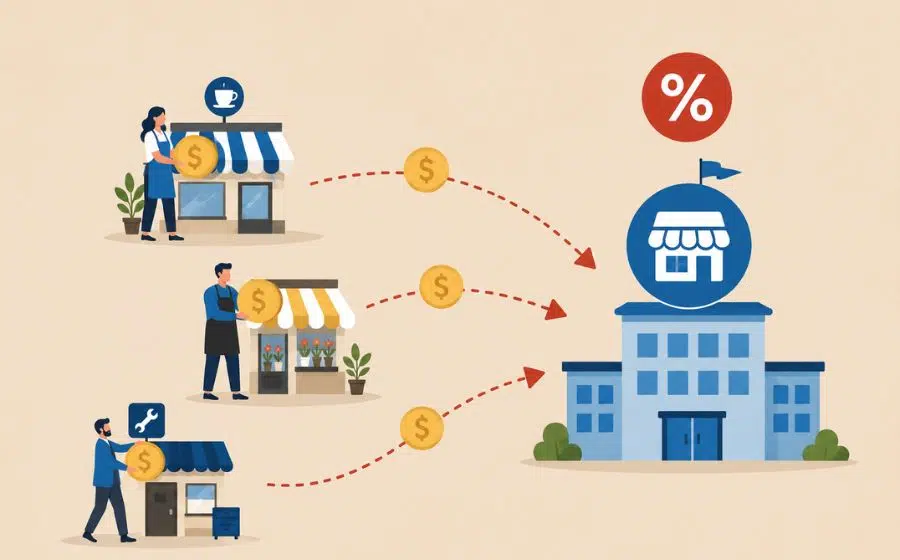
As Retail Lease Sizes Shrink, Franchise Brands Are Finding Smarter Ways To Expand

- Right-sized real estate is about finding a space that truly fits the business — not too big, not too costly and designed to work harder.
- Franchise brands are using smaller, more efficient layouts to lower rent, utilities, staffing needs and buildout costs.
- Brands like Checkers & Rally’s, Kilwins and Camp Bow Wow are using smaller formats to open faster, reach more markets and attract franchisee interest.
- During Small Business Month, the trend shows how smaller footprints can create bigger opportunities for local franchise growth.
May is Small Business Month, but in franchising, “small” is taking on a whole new meaning. It’s not just about local ownership. It’s about smarter, smaller spaces built for growth.
According to Colliers, the average retail lease sizes fell below 3,500 square feet in 2025, the lowest level since tracking began in 2016. What gives?
In today’s economic climate, every square foot has to earn its keep. This shift is called “right-sizing,” and is quickly becoming one of the most effective growth drivers in franchising.
Franchise brands are responding with smaller, more efficient formats that prioritize flexibility over footprint. Walkable, streamlined designs are replacing traditional big-box layouts as operators embrace faster openings, lower costs, and stronger unit economics.
“We’re watching a structural recalibration in how brands approach growth, driven by cost pressures, evolving consumer behavior, and broader acceptance of flexible formats,” says Jon Hill of Morrow Hill Commercial Real Estate. “Brands are prioritizing speed to market and capital efficiency just as much as top-line volume.”
Landlords are adapting, too.
“As we move into 2026 and 2027, we’re seeing much more flexibility around space,” Hill adds. “There’s a growing willingness to break up larger vacancies and accommodate smaller concepts, which is unlocking a wave of second-generation inventory.”
The economics are compelling. Smaller footprints mean lower rent, reduced utilities, leaner staffing, and less capital tied up in buildouts. More importantly, they compress timelines to open, improve ROI and allow brands to expand in tighter, more strategic ways.
Revving Up Growth
The Checkers & Rally’s burger franchise leaned into right-sized real estate in 2025 with a redesigned prototype built for efficiency and scale.
The new model cuts land requirements by 1,000 square feet and reduces the building footprint to just 570 square feet. It also simplifies operations with a single drive-thru lane instead of two, lowering construction costs while opening the door to more markets.
The results are already showing up.
Part of a systemwide reimagining of the brand, the 700-plus unit chain reported a 5.6% increase in sales and an 8.8% jump in transactions since last May, alongside expansion plans across Wisconsin, New Jersey, Pennsylvania, Southern California, Las Vegas, Florida and South Carolina.
Combined with operational improvements, the smaller format is accelerating growth and attracting new investor interest. As CEO Chris Tebben said, “We’re just getting started.”
Smaller Footprint, Sweet Expansion
Kilwins is another sweet example, proving that you don’t need much space if you get the experience right.
The nearly 80-year-old chocolate, fudge and ice cream franchise introduced its “Scoops and Sweets by Kilwins” prototype, a 500- to 800-square-foot format designed for efficiency without sacrificing brand appeal.
The impact is significant with streamlined operations, fewer SKUs, and an estimated 45% reduction in total investment. The first location is on the boardwalk in Ocean City, N.J., and driving serious investment inquiries.
For franchisees, the appeal includes lower barriers to entry, faster buildouts, and quicker paths to profitability. And as footprints shrink, expansion maps grow.
CEO Brian Britton says, “It opens up locations like boardwalks and airports. It opens up smaller footprint locations that you might expect around high transit areas.” With a growing number of multi-unit franchisees across more than 190 Kilwins locations, existing operators are already leaning in with interest to drive the next phase of expansion.
By the way, think this is just for the foodies? Think again.
Less Cost, More Capacity
An award-winning non-food concept with more than 25 years of history is adapting its right-sized real estate approach.
Camp Bow Wow, a 225-unit dog daycare and boarding franchise, has introduced a redesigned prototype that reduces total investment by a whopping $500,000.
By optimizing layout and aligning space with usage, the brand can pursue a wider range of real estate opportunities while maintaining service capacity and unit-level performance. The first location in Dulles, Va., will be one of many and a key driver of multi-unit expansion for the brand.
“This is one of the most significant transformations in the brand’s history,” says Mark Jameson, chief development officer of Propelled Brands. “We’ve taken a proven concept and made it more accessible and scalable. From our refreshed look to a more efficient footprint and lower investment range, everything we’ve introduced is focused on helping our franchise owners grow more profitable businesses.”
The road forward includes more flexible site selection, stronger multi-unit potential, and broader market reach, creating a more accessible entry point for prospective franchisees while maintaining the premium experience pet parents expect.
As Spaces Shrink, Growth Evolves
The International Franchise Association’s 2026 Franchising Economic Outlook report projects more than 12,000 franchise units will open this year. It would be easy to frame smaller footprints as a reaction to higher interest rates and tighter capital. But the shift appears far more durable.
“Lower buildout costs and smaller footprints reduce barriers to entry,” Hill says. “That means more operators can get into the system, scale faster, and reach profitability sooner without taking on the same level of risk we saw with larger formats.”
That feels both sexy and more permanent as franchise brands prove that growth doesn’t have to be tied to bigger boxes or heavier investments.
Ultimately, Hill agrees. “This isn’t a temporary adjustment. It’s an evolution in how retail grows. The brands that win over the next several years will be the ones that prioritize adaptability, capital efficiency and site agility. This trend sits right at the center of that.”