

Category Design Helps Emerging Franchise Brands Win Trust, Stand Out and Grow Quickly
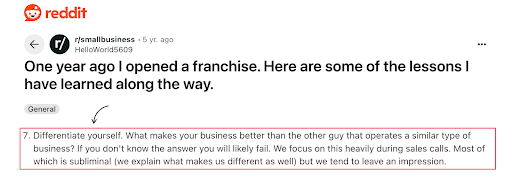
A few weeks ago, I stumbled on a Reddit post from someone reflecting on lessons learned after opening and running a franchise. I don’t usually take brand advice from Reddit, but point No. 7 (below) stopped me. It basically said: ‘If your brand doesn’t stand for something, it’ll get priced like everything else.’ It’s harsh but also dead-on.
As an emerging franchise brand, you must win on two fronts: gain customer loyalty and earn franchisee trust.
If you can’t clearly explain why your business is different from others selling the same thing, you’ll struggle to stay relevant. That’s because most brands position themselves around features, efficiency or margins and try hard to systemize every part of the model, except defining and owning a distinct space.
At their core, franchisees look for more than operational soundness. When evaluating opportunities, they also look for long-term relevance, brand clarity and cultural traction.
Where Category Design Starts to Matter
Category design is a starting point for any breakout brand that wants to win on its own terms. It’s a strategy that introduces a unique market perspective, language and structure, positioning a brand as the defining reference for a new market space.
Why do you think many hotels sued Airbnb as “illegal hotels”? That’s because Airbnb made people see lodging through a completely different lens.
As a result, category design reframes how people define a problem and recognize the solution.
Why Franchise Category Creation Matters Early On
Franchisees are constantly evaluating which brands are worth backing. Without a clear category, you leave it to others to decide what your brand is and who it compares to. That often results in a diluted positioning and weak differentiation. Franchise category creation removes that uncertainty.
If you’re thinking this is just a branding problem, look at the data.
A global analysis by Kantar BrandZ and Oxford University’s Saïd Business School looked at 872 brands across industries. It found that the most powerful predictor of stock market growth was consumer-perceived difference. In other words, brands that feel different outperform financially.
That tracks with what Harvard Business Review found, too. It studied the Fortune 100’s fastest-growing companies, and just 13 category-creating brands accounted for more than half of all revenue growth and nearly three-quarters of market cap gains.
It’s no coincidence that the brands leading in franchise category creation are the ones outperforming the rest.
Here’s a Six-Step Framework for Category Design
1. Make Sure a New Category Is Actually Needed
It begins by clarifying whether one is needed at all. A concept might feel new to the founder, but if the market can’t distinguish it and name the shift, it won’t work. If the idea doesn’t justify a new space, don’t force it.
2. Select the Right Problem
Pick a pain the market already feels. Category design can amplify dissatisfaction by reframing a recognized problem. Drybar saw women booking full-service salon slots just to get a blowout, paying for cuts and color they didn’t need. By isolating that hassle, Drybar turned the “blowout” into a fast, affordable ritual.
3. Frame a New and Different Future
Show how the old way is broken and what life looks like after the shift. Drybar recast styling as a 30-minute pick-me-up, separate from cutting and coloring. Turning blowouts into a quick, affordable ritual, it made the full-service salon visit feel unnecessarily slow. When the market can picture that contrast, sticking with the status quo starts to look irrational.
4. Name the Solution
Stamp the space with a name people can repeat without effort. Keep it short, clear, and self-explanatory. For Drybar, it was a ‘blowout bar.’ Two words that turn the service into a place and give customers the perfect phrase to share. A sticky label does the marketing for you.
5. Evangelize the Category Nonstop
A category lives only if the market adopts and repeats it. Founders must lead the initiative and repeat the narrative across all messaging, customer experience, and internal alignment until the story becomes the default mental model. In franchise category creation, this means training franchisees to use the same language and equipping them with tools to carry the message locally. Consistency builds credibility, and credibility accelerates adoption.
6. Invite Rivals to Adopt the Frame
Growth accelerates once others start describing themselves in your terms. Orangetheory’s heart-rate training became so central that F45, Barry’s, and many other fitness brands integrated similar tech and language, making it clear that Orangetheory had defined the space. Push the frame at conferences, with early adopters and in the press. When the industry speaks your language, you stay at its center.
Define Your Lane Before the Market Does
When you declare a category and back it with a coherent story, you remove the guesswork for customers and prospective operators alike. Instead of comparing you to a row of look-alike concepts, the market accepts your frame and judges you on your terms. That shift often leads to lower acquisition costs, accelerated franchise signings, and organic word-of-mouth.
Financials remain essential, but experienced franchisees also weigh momentum, cultural relevance and future resale value. A derivative brand signals capped upside while a clearly defined category signals open runway. By owning your category and telling a clear story, an emerging brand can command attention, create demand and grow in long-term value. And in the absence of that clarity, your brand ends up where most do: priced like everything else.