In Times of Crisis, Clear and Honest Messaging Can Reinforce Trust Across Franchise Networks
When I shared a branded post on social media that got more than 100K impressions, I knew I hit a nerve. That’s what happened recently when I included a social media graphic from McDonald’s on my LinkedIn feed.
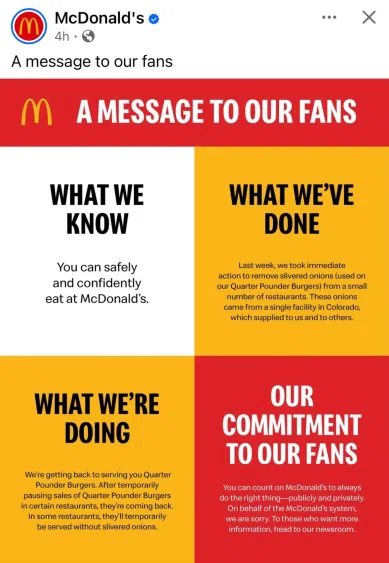
In response to an e-coli outbreak that resulted in one confirmed death and sickness for many, the brand pushed out a deftly well-crafted image that communicated transparency, honesty, accountability and an apology. Notably, it followed up with the same image in Spanish too.
From that one branded social media post to multiple press releases, YouTube videos and more, this was a teachable moment on crisis management and a chance to highlight the importance of preparedness over mitigation.
Alicia Kelso, executive editor of Nation’s Restaurant News, appeared on the “NRN Extra Serving” podcast and said, “Lord knows it’s been a challenging year already. And now as the industry is trying to claw back many of the customers who have left his year because of pricing, now the industry has to do a job getting those consumers to come back by convincing them that it’s safe to come back.”
I agree. I don’t wish a crisis on anyone. But in the franchise space, they most certainly happen. It’s how a brand responds in that pinnacle moment that can make all the difference. And in this case, McDonald’s did not disappoint.
The social graphic that commanded attention was entitled “A Message To Our Fans” and included sections for “What We Know,” “What We’ve Done,” “What We’re Doing,” and “Our Commitment To Our Fans.” Everything was packaged neatly in one space and then invited readers to visit the online newsroom of the company website for more information.
That’s where an entire section called “Always Putting Food Safety First” offered a step-by-step series of actions and communications that took place from Oct. 22 – 30. It included public-facing comments, a review of the company’s food safety protocols, and the swift work and partnership with McDonald’s and government authorities [including the CDC, FDA, USDA, FSIS, Colorado Department of Agriculture and more]. In addition, there were internal company communications to read [yes, internal] from the North American Chief Supply Chain Officer Cesar Piña to team members, as well as links to two informative videos on YouTube from President of McDonald’s USA Joe Erlinger addressing the public at-large.
Crisis Management Strategies for Franchisors
The breadth and scope of how an organization of this size and responsibility took immediate action with all of the important players in painstaking and transparent detail is both admirable and a lesson for others.
That lesson: Don’t wait for a crisis to occur to figure things out on the fly. Put systems in place to respond in the best way for all involved.
Notice how you don’t see “no comment” anywhere in any of this? Nope.
Instead, the organization addressed four areas of crisis management that all franchisors should consider in a similar fashion:
- Be Transparent: Do this even if it means that you are sharing information as it becomes available. “This is what we know so far” can go a long way. Speaking publicly only through lawyers or PR agencies on the other hand can backfire.
- Be Timely: The longer you wait to address a situation, the more you open things up to criticism, rumors and innuendo.
- Be Cooperative: Work with authorities. Be partners to get in front of a problem, respond, protect the brand, and see things through to the other side. It’s important to note that as McDonald’s was issuing statements in its work with authorities, the CDC and others were doing the same.
- Be Trustworthy: Be accountable, apologize, and regain trust. These things all work together.
According to PR News and the 2023 edition of “Crisis Tracker: The Annual Data Briefing on Crisis Management,” 60 percent of communication teams say it usually takes fewer than two weeks to return to ‘business as usual’ after a PR crisis begins.
What’s Next for Crisis Management?
I’m sure the presidential election helped to divert the country’s interest in this particular example. But here we are and things are moving forward for McDonald’s.
The takeaways, however, should live on. That means that every franchisor should examine if you are equipped and prepared to address a crisis of your own. Psst. Having a PR agency on standby is not the sum answer here.
Sixty-five percent of respondents in the PR News brief say their teams, or those they represent, are prepared to respond to a crisis. That leaves 35 percent up for grabs.
Additionally, fewer than half of PR professionals said they are confident that their organizational leadership, or the C-suite at their clients’ organizations, is prepared for crisis situations that require communications and media responses.
Clearly, there is work to be done, especially so an entire brand doesn’t become undone.
Here’s to planning, everyone.