

Founder Mary Wetherill Makes Farm-to-Table a Reality through Sustainable Urban Gardening
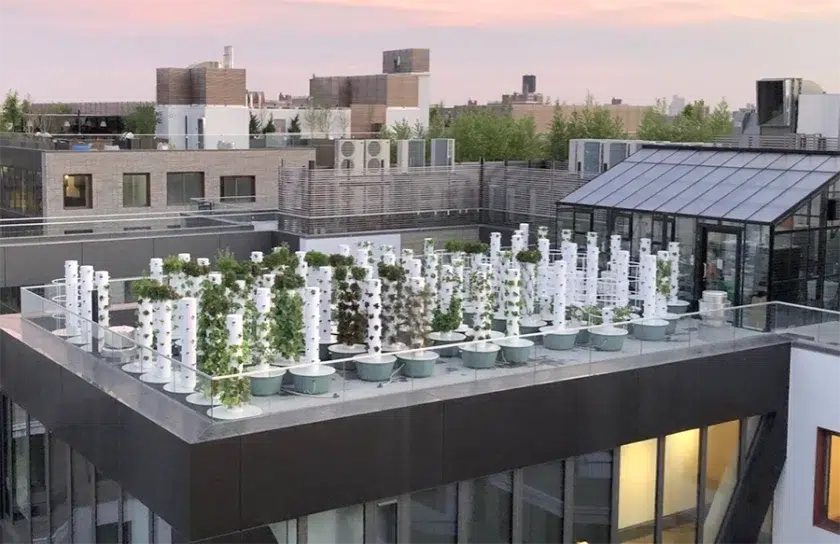
Imagine verdant city rooftops covered with towers of organic, sustainably and hydroponically grown vegetables and herbs. Or residential and office complexes, senior centers, correctional facilities, restaurants, hospitals and schools all growing food year-round in interior urban gardens. These scenes are not imaginary – and they’re proliferating, thanks to the Jersey City, N.J.,-based Green Food Solutions franchise.

Founded in 2017 by CEO Mary Wetherill, Green Food Solutions is now growing through franchising. Wetherill dreams big, but she gets things done. Of about 60,000 corporate and residential buildings in Manhattan alone, Green Food Solutions is in 14, she says. “I don’t think you could get 100% of a market, but in 60,000 buildings, we could produce 4 million pounds of lettuce alone! That gets trucks off the road, gets government attention, and you’re going to have fewer pollutants in the air. We’re nowhere near that point, but empowering people to do that in other cities, that’s possible. I really believe that.”
Sustainable Urban Gardening
And here’s the reality:
- Green Food Solutions’ vertical gardens are an amenity in locations such as residential buildings where developers have successfully touted them to entice residents while enhancing their sustainability practices.
- The leafy towers are providing fresh food for residents, office workers, restaurant patrons and others on site, with produce also distributed to food pantries.
- The gardens are the basis for nutritional education for pre-natal patients in a hospital system, as well as lessons for students in STEM (science, technology, engineering and math) and STEAM (STEM plus “art”) and inspiring young people to make healthier lifelong habits.
- They’re helping a hospitality company in Kenya promote agritourism and its farm-to-table cuisine.
- And they’re even proving to be therapeutic, calming and endorphin-inducing (as anyone who’s planted a seed that grew into a tomato will attest).
“The layers at which people are using food and farms is really amazing, and we’re really happy to be a part of that,” Wetherill says. “Our mission is to empower a new local food system for our health and the health of the planet, and we can’t do that alone.” And that’s where franchising comes in.


Wellness Entrepreneur and Farmer
Wetherill, whose mother suffered from diabetes, began her personal health journey more than a decade ago. Then a massage therapist with her own studio, she began focusing on exercising and eating more nutritious, organic foods. “I started counting chemicals, not calories,” she says, and lost about 90 pounds in the process.
Her partner, Electra Jarvis, worked in agriculture and introduced Wetherill to vertical farming. Wetherill was immediately fascinated and sought to learn more. She and Jarvis participated in Square Roots, a program co-founded by Elon Musk’s brother, Kimbal Musk, that involves farming in shipping containers. Wetherill and Jarvis used that experience as training. “We learned the ins and outs of machinery and automated technology, reached out to manufacturers, built relationships with them, went to all the trade shows and learned more about vertical farming,” she says.
After a year with Square Roots, they leased space in a greenhouse atop an affordable housing building in the Bronx. “As we’re shipping food into Manhattan, to restaurants and other places, connecting B2B and B2C, we’re seeing none of this food we’re growing is going to people in this building. Ultimately, we wanted to solve that problem. Green Food Solutions became just that.”
The Business Model
Instead of growing and selling produce, Wetherill ultimately decided to grow and sell farms. The developer of a 900-unit, mixed-use building in Brooklyn bought into the concept, enabling her to refine the business model. “We had a tower farm, a huge vertical hydroponic farm on top of this building, and all the food was free to people in this building,” Wetherill says.
As Green Food Solutions evolved, Wetherill assumed the helm as CEO and Jarvis continued work in other agricultural endeavors while remaining a Green Food Solutions mentor. The idea to franchise Green Food Solutions came from a friend, she says. “I looked into it and realized that franchising actually aligns with our mission to empower other businesses.”
A franchise owner has multiple revenue streams available, she says. These may include conducting agriculture-related workshops to interested groups (which often result in sales), as well as sales to organizations or individuals who want to maintain their own growing systems. But the primary revenue stream for a franchise owner involves selling the hydroponic growing system, installing the equipment, providing planning and design as needed, and selling and maintaining service contracts.
Clients typically include developers who want farm amenities in their residential or commercial projects. Service contracts range from $30,000 to $50,000, Wetherill says. One of the benefits for a franchise owner is that Green Food Solutions has developed an extensive pipeline of potential clients – developers, nonprofit organizations and businesses in locations around the U.S.
The Green Food Solutions Franchisee
“First and foremost, a successful franchise owner is going to be someone who is passionate about impacting their local food system,” Wetherill says. “We’re really looking for someone who is going to be hands-on in the business and not looking to completely staff it initially. As the business grows, the franchise owner will need to hire growers to manage the service locations while the owner is taking sales meetings in the office. Or maybe the franchise owner wants to be the grower and is hiring sales people. The core value or skill of a franchise owner is to be personable, be an educator of sorts, someone who really likes to make a difference with people.”
Gardening or technical experience is not required. And while sales experience is helpful, Green Food Solutions has developed scripts and templates to help franchise owners with marketing and sales. She and her team also will accompany new franchise owners in checking out locations for vertical farms. “One of the things we’re known for is our support,” Wetherill says. “We want to make sure we’re on those calls with you, helping you until you feel comfortable navigating those conversations with developers or community directors or restaurant owners,” she says.
While a franchise owner does need to be able to show and demonstrate the equipment to potential clients, there’s no need for an extensive area, she says. The equipment can be in an office or co-working space, for example. “We also work with developers to help find spaces,” she says. “Affordability and accessibility are what we’re all about.”
For more information about the Green Food Solutions franchise, visit https://www.greenfoodsolutions.com/franchise.



